Do you need to develop your leadership communication skills?


On Thursday, October 20, 2016 I will be facilitating the Effective Organizational Leadership: Engage and Execute program at Kent State’s Regional Academic Center in Twinsburg. This program is designed to help current leaders get the best out of their employees. Do you know that 44% of employees admit to doing as little as possible and getting away with it? So what can leaders do to encourage employees to give their best? 

Great leadership is about communicating, engaging and adapting to get results. One of the best ways to do this is to provide employees with immediate and timely feedback. Employees need to know where they stand, but in a way that reduces their defensiveness and motivates them to change their behavior. This program will provide you tips, models and best practices to do just that, along with many other key leadership ideas that will help make your job easier, less stressful and more rewarding. 

Join us! For more information about this program, please visit the link below.

http://www.kent.edu/yourtrainingpartner/effective-organizational-leadership-engage-and-execute?utm_source=LinkedIn&utm_campaign=2016-10-4%20Effective%20Organizational%20leadership

Know the Secret to Improving Your Workplace?

Focus on what’s right!  It is so easy to get caught up in what employees are doing wrong; “What did he do this time?  Why does she act like that? Who is going to screw up today?” A supervisor’s job is to look for problems and fix them, right? Here’s a different approach – look for the strengths, potential and successes of each employee and build on them.  

The idea of strengths-based leadership works. It shifts our mindset, and also lets employees know that we are paying attention. We are not only noticing the areas that may need work, but also what makes each individual unique and valuable to our team and our organization. 

To create positive workplaces, we must change the questions we ask. Questions help to focus attention. Here are questions that may help move toward a more positive mindset for both supervisor and employee:

Can you think of a time that you’ve faced this challenge before?  What did you do to overcome it?

Tell me about a time that you felt as though you were at your best. What were you doing?

If you came to work one day and the job had significantly changed for the better, how would you know?

What are you most looking forward to in the future?

What can you start doing today or tomorrow to begin working toward your goal?

These types of questions can move the conversation ahead, and in a direction that is motivational and empowering. Instead of dwelling on what is wrong, find specific ways to engage staff in focusing on times they have faced challenges and were successful.  Always remind them who they are when they are at their best. Focusing on what is right is the most basic way to build relationships, improve employee performance and enhance workplace effectiveness.


The following is a great resource for information regarding utilizing positive questions in the workplace:

“Encyclopedia of Positive Questions – Using Appreciative Inquiry to Bring Out the Best in Your Organization,” by Diana Whitney, Amanda Trosten-Bloom, David Cooperrider and Brian S. Kaplin.  (2013)


I partner with Kent State’s Center for Corporate and Professional Development to facilitate courses that help companies with their talent development needs. For more information about how we can help your organization, please click the link below.

http://www.kent.edu/yourtrainingpartner/kristy-frieden-0?utm_source=LinkedIn&utm_medium=LinkedIn&utm_campaign=2015-11-23%20Frieden



Reframing Feedback

What is the purpose of conducting Performance Reviews? Even though it isn’t the most popular activity for supervisors, in a majority of organizations, it is required.  So it may help to take a moment to reflect on why we do them in the first place. 


At its core, the performance review is a tool that can (and should) be used to facilitate communication between you, the supervisor, and the employee.   Your employee needs to know what your expectations are, and how they’re doing in meeting your expectations; plain and simple.  The difficulty comes when you have to tell the employee something they may not want to hear.  If you’re like most of us, you agonize over how to communicate this message, and may even sugarcoat it a bit to ease the blow.   In sugarcoating, you may dilute the message, leaving the employee confused and unsure of the steps they need to take going forward.  This is not the answer.


When providing difficult feedback, it is critical that you utilize behaviors when communicating what the employee needs to stop, start or continue doing.  For example, let’s say your employee “Sally” has a bad attitude, and during the last staff meeting she went out of her way to communicate her disapproval to everyone.  After the meeting, instead of telling Sally you didn’t appreciate her “bad attitude,” it would be more effective to tell her that you observed her “eye rolling” and heard the negative comments she made to her neighbor while you were sharing the new company policy with the group, which is not acceptable.    Utilizing specific behaviors, instead of generalizations, most often takes the emotion out of the conversation and places the responsibility squarely on the individual.  Going forward, Sally knows exactly what your expectations are, and what she has to do (or not do) to meet your expectations. 


Utilizing behaviors is also just as important when communicating to an individual what they are doing well.  For example; after a presentation, if my boss tells me “You did a great job!” I may be happy for the acknowledgement, but I don’t know exactly what I need to continue doing i.e.; providing an agenda, keeping the meeting on time, encouraging everyone’s input.  Whether you are completing an annual performance review or giving informal feedback, communicating specific behaviors is the key to effective, actionable feedback. 


If you are interested in learning more about providing effective feedback, completing meaningful performance reviews that drive accountability, avoiding rating errors or the performance management process in general, look for the open enrollment program, Differentiating Employee Performance and Creating Accountability that I will be offering through Kent State’s Center for Corporate and Professional Development in the Spring of 2016.  


What is your Personal Interaction Style?

The Personal Interaction Style® assessment by Lockwood Leadership International is one of my favorite self-awareness tools. The profile itself is easy to complete (58 yes/no questions) and the information discovered about oneself and others is simple to understand. More importantly, it has been my experience that the applicability in the workplace yields immediate, effective and long-lasting results.

Did you ever wonder why you “click” with some people easily, while others are more difficult?  Each of us has general tendencies and behaviors that we exhibit while expressing ourselves.  Some people can be very quiet and reserved, while others are loud and expressive. Through the Interaction Style profile, all of us fall into one of four categories – Expresser, Director, Analyzer or Relater. Expressers tend to be very talkative, humorous and enthusiastic, with a focus on the big picture. They are excellent promoters. Directors tend to be the take-charge types who get the job done. They are decisive with a primary focus on results. Analyzers tend to be reserved and fact based. They are systematic in their approach and focused on getting the job done right. Relaters are ultimate team players. They tend to be excellent listeners and easy to approach. They are focused on how decisions impact the group as a whole. It is important to note that one style is not better than another is, and you need all styles in a team setting to get the best results.

On a recent trip to San Juan, Puerto Rico where I delivered training as part of an ongoing series of programs that Kent State’s Center for Corporate and Professional Development is delivering for DDR, I utilized the Personal Interaction Style assessment to help participants discover their styles. The group was then able to learn how to work with the other styles more effectively, by giving them what they need. They also learned how to “flex” their style to be more influential with others.

I have utilized this assessment with hundreds of people, and each time I do it, I am amazed at the accuracy of this simple assessment and the applicability of the information learned.


What is your mindset?

As we understand the topic of emotional intelligence, self-awareness stands out as the key foundational concept that all others are built upon.  We must be self-aware in order to be successful in business, and in life.  An important area of self-awareness is mindset.  How do we look at the world?  How do we view events and situations that happen to us on a daily basis?  We would all like to think that we have a “learner” mindset; that is, we approach situations with an open mind, looking for growth opportunities in challenges, and continually questioning our role in events so that we can learn from them.  However, many of us tend to fall into the “judger” mindset; that is, looking to blame others, making assumptions and being critical when the going gets tough.

Picture this….you’re diligently working on a project and are very pleased with the progress you’re making.  Suddenly you get a call from your boss.  He is in a panic because one of your co-workers’ has “screwed something up again,” and needs you to fix it, “IMMEDIATELY!”   In that moment, what thoughts go through your head?  Judger thoughts sound like, – Why is this happening to me today?  Why is my boss such an over-reactive jerk?  Why does he always make me fix everyone else’s mistakes?  Doesn’t he know I have my own work to do?  I can’t stand this place! 

Sound familiar?   It is so easy to get sucked into a judger mentality.  Next time things don’t go as planned, try taking a deep breath and intentionally asking yourself some learner questions… What happened?  What can I do to help?  What’s useful about this?  What can I learn from this situation?  What’s best to do now? What’s possible?  It takes practice, but the potential outcome for you and your organization, may be greater than you could ever imagine.   Try it!!

Featured Speaker for Akron SHRM

Recently I was the featured speaker at the Akron Area Society of Human Resource Management Strategic Conference. My sessions were “Utilizing Calibration to Differentiate Performance” and “Back to Basics- Developing Better Succession Planning.”  I enjoyed the opportunity very much, and I would like to thank Jim Krosky for inviting me.  I met a lot of wonderful HR professionals that day, who are all working hard to bring the best HR practices to their organizations.

During my sessions, there was much interest in the development and evaluation of organizational values.  I shared some examples of values with attached behavioral anchors, and wanted to reiterate the point that these anchors need to be specific behaviors.  Think of a behavior as an observable fact; something that you can see or hear someone say or do.  An inference on the other hand, is your opinion and something that you conclude.  Let me give you an example.  If I say that Jane is “sloppy,” this is an inference.  What behavior would make me infer that Jane is “sloppy”?  There are several answers to this;  her uniform is wrinkled, her desk is cluttered, her work has errors.  These are behaviors.  It is an important distinction to make in performance reviews.  Driving to behaviors gives employees more valuable feedback that is actionable.  It also takes the emotion out of giving negative feedback because it can not be disagreed with as easily. Attached behavioral anchors to organizational values gives your employees specific ways to demonstrate and live your values.

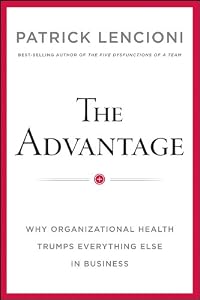
For more information on sourcing organizational values I suggest the book The Advantage, Why Organizational Health Trumps Everything Else in Business by Patrick Lencioni (2012).

The Advantage

I’m Daring Greatly

When I first started my business, a friend of mine suggested that I blog about the books that I read.  I am an avid reader and what you’d call a self-help book junkie.  I guess I think I’m going to find the “magic words” that will cure all of my problems and help me to live happily ever after.  Well…I have not found the “magic words” yet, but I have found a lot of great information pertaining to all kinds of topics…from leadership to mindfulness, metaphysics to emotional eating, and much much more.  So, in the spirit of daring greatly, I have decided to be a better blogger, share my opinions, write more frequently and let you know what I’m reading and why I like it.   I have just finished reading the book “Daring Greatly” by Brene Brown.  Front Cover

I first saw Brene on Oprah’s Super Soul Sunday a few weeks ago, and was glued to the TV.  Brene talks about the topics of vulnerability and shame.  Yes, I know…not the most inspiring topics, but her ideas really rang true for me and a lot of other people I know.  I could relate to everything she said, but especially about how the fear of feeling vulnerable can prevent us for going after our dreams.  We are often so concerned about failing or about what other people think of us, that it keeps us quiet and trapped in a life that is shallow and exhausting.  We have a deep desire to be loved for who we are, but don’t let anyone see the “real” us for fear we will be rejected.  In my life, I have certainly struggled with people pleasing.  I was an only child who desperately wanted my parents approval, so I worked VERY hard at being the kid they wanted me to be.  As I grew up, I tried to do whatever I could to please the authority figures in my life..coaches, teachers, bosses but it seemed the more I tried, the higher they would raise the bar, leaving me frustrated and feeling like I would never be “enough”.   I have finally stopped living my life for everyone else, and have started going after my dreams.  It feels FANTASTIC!!!  I still struggle with wanting others to like me, but I am learning more and more not to to care so much.  As I’m learning this, I am also trying to teach my 11 and 8 year old daughters to do the same.  I want them to believe in themselves and have the courage to be who they are, regardless of what anyone else thinks, does or says.  We all need to find the courage to show our “real” selves to the world.  So be brave and dare greatly!!!!

How High is Your Emotional Intelligence?

How high is your Emotional Intelligence?  Studies show that the level of your EI is a better predictor of success than your IQ.  Luckily, unlike IQ, you can increase your emotional intelligence with some awareness and practice.  Emotional Intelligence is made up of four competencies; self-awareness, self-management, social awareness, and relationship management.  To begin increasing your EI, start by becoming more self-aware.  Self-awareness is a very broad topic, so starting with your strengths is key.  Focusing on what you do well, instead of your weaknesses, will give you the energy and enthusiasm to grow and develop your EI.   The strengths based assessments that I utilized most often are included with  books like; Strengths Finder 2.0 by Tom Rath, Strengths Based Leadership by Rath and Conchie, and Stand Out by Marcus Buckingham.  Each of them gives you a detailed report of your core strengths and how to utilize them to maximize your true potential.  Once you have increased your self-knowledge, it is just as important to put that knowledge into practice.  Try to utilize your strengths every day.  As you begin to incorporate them in all aspects of your life, your self-awareness will continue to grow and you’ll feel energized and more accomplished too!

Thank You Enlightened Women!

It was a true blessing to meet all of you that attended my presentation, “Discovering Your Best Self: Intentionally Creating Work/Life Imbalance” yesterday at Kent State University’s Women in Business Conference.  Your enthusiasm and interest in the topic was inspiring and I enjoyed sharing with you my personal journal to leading a strong life.  As I mentioned during my presentation, please take the time to keep track of your strong and weak moments for a least a few days.  I guarantee you’ll find some interesting insights about yourself.  Once you’ve done that, see how they apply to each domain of your life, and begin taking the steps to create more of those moments.  Finally, I REALLY recommend you completing a personal vision card, placing it everywhere, and spending some time visualizing it everyday.  Believe me when I tell you, IT WORKS!!!!!  Thank you again, and please let me know how these ideas work for you, or how I can help you discover your best self!

Happy 2013!

My New Year’s resolution in 2013 is to find more inner peace. I believe that to find inner peace you need to be true to yourself. You need to be as authentic as possible in all situations.  Sometimes that can be very difficult, but knowing yourself, and then doing something about that knowledge is essential.  Toward the end of last year I read the book Find Your Strongest Life by Marcus Buckingham. In the book  Marcus talks about intentionally creating imbalance in your life.  To do this you must first observe (and write down) what activities in your life make you strong, and what activities make you weak.  Strong moments are defined as those activities that make you FEEL strong.  Weak moments, on the other hand, or those activities that make you FEEL weak.  The key word here is FEEL.  Your emotions are your guide.  So once you have determined those moments you need to intentionally imbalance your life toward those strong moments by doing more of them.  Also trying to do less of the activities that drain you.  Awareness is the first step in this process and so far it has been pretty eye opening.  I have discovered that the theme of my strong moments is being in the presence of others and truly connecting with them.  My weak moments, in contrast, happen when I am alone or doing something that causes me to not be myself.  In order to lead, teach or help others, all of us first need to get to know ourselves.  By taking the time to discover our weak and strong moments, we can authentically move through life with more inner peace.